
How to Choose a TFT Display for Excavators, Bulldozers, and Heavy Equipment: An Engineer's Guide
Designing a Human-Machine Interface (HMI) for off-highway vehicles requires a fundamental shift in mindset from traditional electronics design. An excavator, wheel loader, or forestry machine presents one of the most hostile environments for an LCD module. The display must survive continuous low-frequency vibration, massive temperature swings, high ambient sunlight, and operator abuse, all while accurately reporting critical machine states.
1. What Makes Heavy Equipment Displays Different from Consumer Displays?
Engineers transitioning from consumer electronics or standard indoor industrial design often underestimate the demands placed on a vehicle HMI display. A consumer tablet is designed for a controlled 10°C to 30°C environment, features a lifespan optimized for 2 to 3 years, and utilizes high-gloss glass that acts like a mirror in direct sunlight.
In heavy equipment, the display is a safety-critical component. If the screen fails, the operator cannot read the engine coolant temperature, hydraulic pressure, or rear-view camera feeds, grounding a machine that costs thousands of dollars an hour to operate.
Heavy equipment displays require:
- Extended product lifecycles: Equipment is manufactured for 5 to 10 years and serviced for 15. The display cannot face End of Life (EOL) for at least 10 years.
- High luminance and wide viewing angles: Heavy Equipment cabins consist largely of glass. The screen must overpower ambient sunlight and remain visible as the operator shifts in his seat.
- Industrial-grade interfaces: Short-run TTL interfaces are highly susceptible to noise. Industrial displays rely on differential signaling (LVDS) to cross the cabin while resisting electromagnetic interference (EMI).
- Thermal resilience: A bulldozer parked overnight in a Canadian winter or a wheel loader operating in an Arizona sunny summer day will expose the display to temperatures far outside consumer limits.
Engineering Takeaway: Never specify a commercial-grade tablet or consumer TFT for off-highway equipment. The initial cost savings will be entirely consumed by warranty claims, field replacements, and frustrated operators.
2. Operating Challenges Inside Excavators and Bulldozers
Understanding the physical environment is the first step in display selection. The cabin of heavy machinery introduces a specific matrix of challenges.
Sunlight and Glare
Excavator and forestry machine cabins are effectively glass boxes designed for maximum visibility. Direct sunlight washing out the screen is the primary complaint from operators. A standard 300-nit display will appear completely black in these conditions. Furthermore, the greenhouse effect inside the cabin can drive localized temperatures immediately behind the glass well above the ambient outdoor air temperature.
Continuous Shock and vibration
Diesel engines and hydraulic pumps generate constant low-frequency vibration. Tracked vehicles like bulldozers transmit high-impact shock through the chassis when traversing rocky terrain. Connectors can vibrate loose, heavy components on the PCB can suffer fatigue failures, and the LCD glass itself can crack if mounted too rigidly against the bezel.
Wide Temperature Swings
Equipment must turn on and function reliably whether it is -20°C or +70°C. At extremely low temperatures, the liquid crystals in standard displays lose their viscosity, resulting in severe ghosting and unacceptably slow response times. At high temperatures, backlight LEDs degrade rapidly if their thermal path is insufficient.
Operator Interaction
Operators wear thick, dirt-covered, or wet gloves. They stab at the screen rather than tapping it. The touch panel must be tuned to reject water droplets, ignore dirt accumulation, and register inputs through heavy leather or nitrile.
3. Engineering Checklist Before Choosing a TFT Display
When evaluating an LCD module for an operator cabin display, use this baseline checklist to filter out unsuitable candidates:
- Luminance: Minimum 800 nits. Anything less will struggle in daylight.
- Contrast Ratio: Minimum 600:1 to ensure readability of text and icons.
- Viewing Angle: 85/85/85/85 degrees (Full viewing angle).
- Operating Temperature: -20°C to +70°C minimum.
- Backlight Life: 50,000 hours minimum to half-brightness.
- Interface: LVDS for video; USB or ruggedized I2C for touch.
- Touch Panel: Projected Capacitive (PCAP/CTP) with a chemically strengthened cover glass.
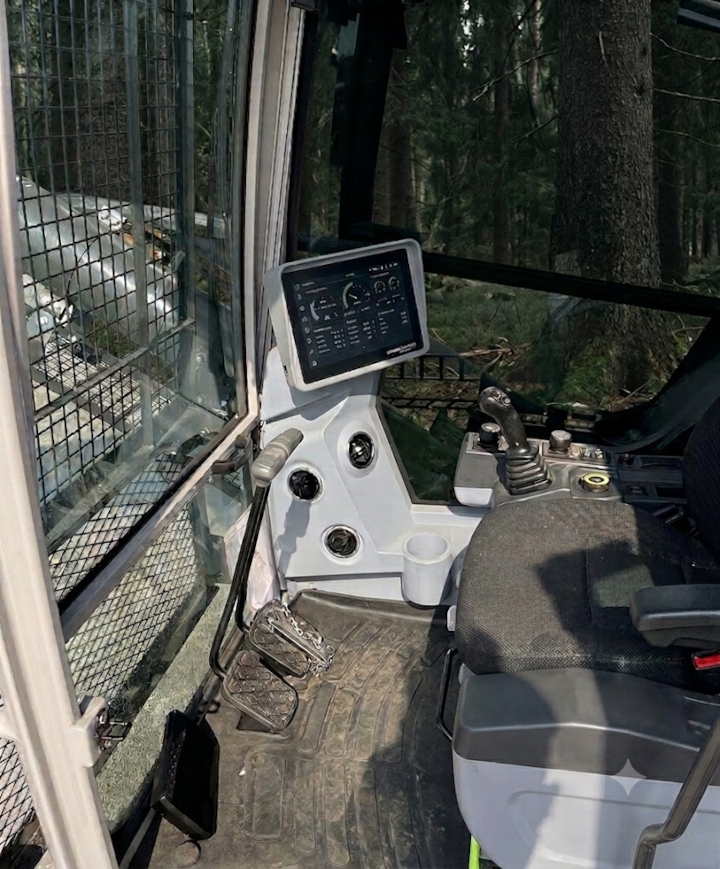
4. Why the LMT101DNLFWD-NND-1 Fits Heavy Equipment Applications
To illustrate how specifications translate to field performance, we will analyze the TOPWAY LMT101DNLFWD-NND-1, a 10.1-inch LCD module explicitly suited for off-highway vehicle HMI.
Form Factor and Resolution
At 10.1 inches diagonal with an active area of 216.96 x 135.60 mm, the display offers substantial real estate for complex graphical clusters (engine RPM, fuel, hydraulic temps, and camera feeds). The 1280 x 800 (WXGA) resolution provides a 16:10 aspect ratio, which is highly preferred in industrial applications over 16:9 as it offers more vertical space for gauge rendering.
Optical Performance
The module features a luminance of 850 cd/m2 (nits). This crosses the threshold into "sunlight readable" territory. Crucially, the display utilizes a "Normally Black" a-Si TFT structure.
- Why it matters: In a Normally Black display, when a pixel is unpowered, it blocks light. This yields a much higher contrast ratio (800:1 typical) and darker blacks compared to older TN (Normally White) panels. When an operator is viewing the scr