
10.1" Sunlight Readable TFT LCD for PCS: Solving Outdoor HMI Failures
Solving the BESS & PCS Outdoor Display Failures Nobody Talks About
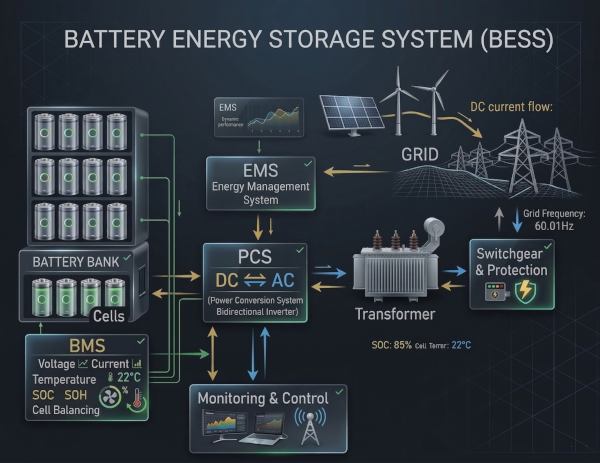
Designing a Human-Machine Interface (HMI) for Battery Energy Storage Systems (BESS) and Power Conversion Systems (PCS) is notoriously unforgiving. When these utility-scale or commercial cabinets are deployed outdoors, consumer-grade screens fail rapidly.
Engineers frequently face blackening screens, EMI-induced touch failures, and complete component death due to environmental stress. Here is a technical breakdown of why standard displays fail in the field, and how industrial-grade modules like the Topway LMT101DNLFWD-BAD are engineered from the ground up to survive grid-level environments.
3 Critical Failure Modes in Outdoor PCS HMIs
1. Isotropic Failures & Sunlight Readability
Direct sunlight (~100,000 lux) introduces two massive problems: glare and thermal loading. Standard displays max out at 300 to 500 nits. We’ve seen 400-nit screens pass factory QA—then fail on day one in Spain when the cabinet door is opened at noon. More critically, when the enclosure's surface temperature exceeds the liquid crystal's clearing point, the screen exhibits "solar clearing" (turning completely black), rendering the local control panel useless to grid operators.
2. EMI inside PCS cabinets is worse than expected
PCS cabinets handle massive high-voltage DC-to-AC power conversions, high-frequency switching (IGBT). This creates severe electrical noise. Standard Projective Capacitive (PCAP) touch panels lack the necessary shielding, resulting in "ghost touches," lagging response times, or a completely frozen interface when an operator attempts interaction.
3. Condensation and Extreme Thermal Cycling
Outdoor BESS/PCS installations across Europe and the Pan-Pacific regions face extreme temperature swings.
- Southern Europe (Spain, Italy): high UV + heat → solar clearing risk
- Northern Europe (Germany, Nordics): cold start + condensation
- Southeast Asia: humidity-driven corrosion and touch instability
This constant thermal cycling draws moisture into the display assembly. Without proper sealing, condensation forms behind the glass, permanently ruining the optics and corroding internal Flexible Printed Circuits (FPCs).
The Environmental Non-Negotiables: IPX5, IK08
Deploying a 10.1" HMI on an unattended outdoor battery storage cabinet exposes the hardware to aggressive environmental threats. Consumer screens shatter or short-circuit under these conditions. Industrial modules survive through heavily tested structural designs.
- IPX5 Rating (Ingress Protection): Standard displays allow moisture to seep past the bezel. The Topway 10.1" module is engineered with an IPX5 rating for seamless integration into high-IP cabinet doors. Precise optical bonding and specialized gasketing prevent low-pressure water jets and microscopic dust from penetrating the critical gap between the Capacitive Touch Panel (CTP) and the TFT cell.
- IK08 Rating (Impact Protection): PCS cabinets are vulnerable to tool drops, hail, or direct vandalism. The front glass of this module is chemically strengthened to achieve a robust IK08 rating. This means it can safely absorb a 5-joule mechanical impact (equivalent to a 1.7kg mass dropped from 300mm) without shattering or compromising the liquid crystal structure beneath it.
Interface Selection: Why LVDS Beats RGB in PCS Environments
When integrating a 10.1" display into a BESS cabinet, engineers must choose between a parallel RGB interface and LVDS (Low-Voltage Differential Signaling). For power conversion environments, the choice is clear:
- The Problem with RGB: A 24-bit RGB interface requires over 30 pins and traces, transmitting TTL logic levels. In a noisy PCS cabinet, these parallel data lines act as antennas, making the display highly susceptible to EMI. RGB typically becomes unstable beyond 20–30 cm in high EMI environments.
- The LVDS Advantage: LVDS transmits data serially over a few twisted-pair wires using low voltage differentials. This inherently rejects common-mode noise, making it highly immune to the electromagnetic interference generated by massive BESS inverters. LVDS also allows for longer cable routing, giving engineers the flexibility to safely isolate the main control board deep inside the cabinet while mounting the HMI on the outer door. The 10.1" Topway module utilizes LVDS precisely for this operational stability.
Standard Display vs. Topway 10.1" Outdoor Module
| Specification | Standard TFT | Topway 10.1" LMT101DNLFWD-BAD |
|---|---|---|
| Brightness | 300~500 nits | 850 nits (Sunlight Readable) |
| Data Interface | Parallel RGB (High EMI risk) | LVDS (High EMI immunity) |
| Environmental | Basic casing | IPX5 / IK08 Rated |
| Touch Performance | Fails with water/gloves | Water & Glove Supported PCAP |
| Quality Control | Basic functional test | Rigorous FQC (Thermal, Aging, Shock) |
When is this module NOT the right choice?
Transparency is crucial in B2B engineering procurement. This 10.1" module is over-engineered for:
- Indoor, climate-controlled residential energy storage (a standard 300-nit display is more cost-effective).
- Applications where the display is strictly used for simple readouts.
- Low-budget consumer electronics.
Frequently Asked Questions (Technical FAQ)
What brightness is optimal for an outdoor BESS display?
For true daylight visibility on an outdoor cabinet without heavy shading, 850 nits strikes the perfect balance. It is bright enough to cut through midday glare while remaining thermally efficient enough to prevent the backlight from overheating the sealed enclosure.
Why is AR (Anti-Reflective) coating is important for BESS HMIs?
High brightness alone isn't enough. AR coating reduces the reflection of ambient light bouncing off the glass. It improves the contrast ratio outdoors, meaning the backlight doesn't have to be overdriven, which extends the Mean Time Between Failures (MTBF) of the LEDs.
The Engineering Takeaway
If your PCS display is designed like a consumer screen, it will fail like one.
Sourcing displays for Power Conversion System and grid infrastructure is an exercise in risk mitigation. Specifying a consumer-grade screen guarantees premature field failures, costly maintenance dispatches, and damage to a brand's reputation.
For B2B energy applications demanding absolute reliability, the Topway LMT101DNLFWD-BAD provides the optical performance, EMI immunity, and manufacturing consistency required to keep systems running globally.
Quick Spec Checklist (Before You Lock Your Design)
- ≥800 nits brightness
- LVDS interface (not RGB)
- -20°C to +70°C
- IP-rated front panel
- Proven FQC process